
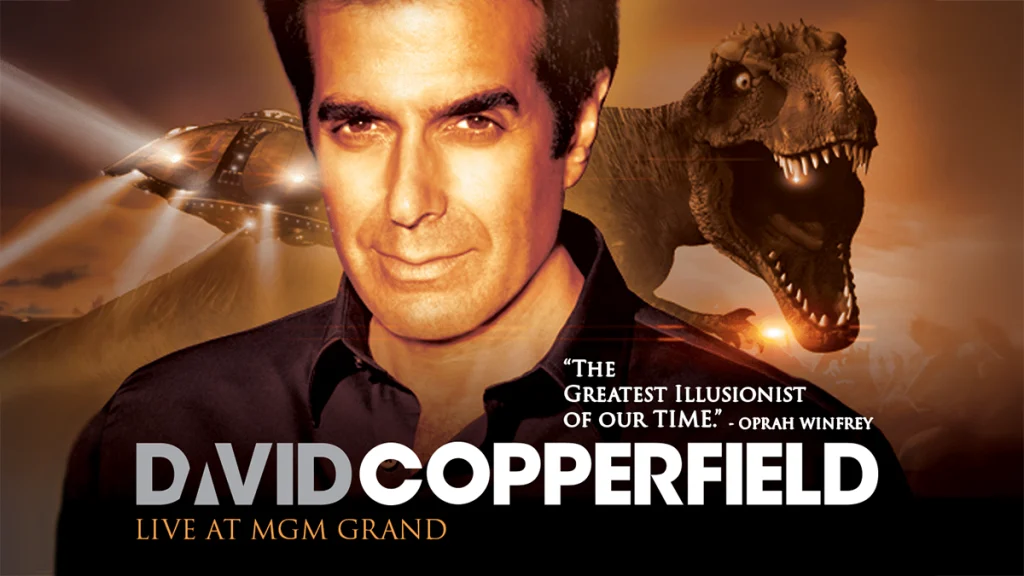
LAS VEGAS, Nevada USA, May 1, 2026 — The final curtain fell at the David Copperfield Theater inside MGM Grand on Thursday, April 30, closing one of the most celebrated chapters in Las Vegas entertainment history.
David Copperfield’s 25-year residency at the MGM Grand ended April 30, 2026, with a 9:30 p.m. performance before a house packed with fellow magicians, longtime fans, and members of the community who had traveled to bear witness.
Over 7 million people from nearly every country on earth had passed through that theater since he first opened there in 2000. The 740-seat room was renamed the David Copperfield Theater in 2013 — making Copperfield one of only a handful of performers in Las Vegas history to earn that distinction. He filled that theater for as many as 15 shows a week, averaging around 500 per year, delivering wonder to audiences in more than 10,000 total performances.
The closing, as previously reported by Conjurly, marked an early end to a contract originally running through the end of July 2026. Holders of tickets beyond April 30 will receive an automatic refund. The closing came ahead of schedule amid circumstances that drew considerable public attention, which are addressed below.
MGM Grand President and COO Mike Neubecker called it a “larger-than-life production” and wished Copperfield well on what comes next. In a social media post the day the closing was announced, Copperfield wrote: “Magic teaches us that often the things that others dismiss as impossible are not only possible — but within our grasp.”
Copperfield first came to Las Vegas as a 12-year-old boy, staying with his family at Caesars Palace. Two decades later he was headlining its Circus Maximus showroom — performing there for nearly 15 years, 10 weeks a year, before opening at the MGM Grand in 2000. Across four decades on the Strip, he became as much a fixture of the city as the neon itself.
Before the Nightly Show, the Impossible Becomes Reality
Copperfield spent the 1980s rewriting what a magician could ask an audience to believe. The scale of those years is worth pausing on.
In April 1983, a live audience seated at Liberty Island watched the Statue of Liberty vanish from sight — its blip disappearing simultaneously from a radar screen, spotlights trailing off into empty air where the statue had just stood. Copperfield was 26 years old. He framed the illusion not as a stunt but as a warning: that liberty itself could disappear if we stopped paying attention to it.
Three years later, he went to China. In 1986, Copperfield walked through the Great Wall — entering one side of the solid structure and emerging from the other. To make it happen, his team had spent the previous year negotiating with the Chinese government for permission, a diplomatic undertaking that matched the ambition of the illusion itself.
The grand illusions kept coming. He levitated over the Grand Canyon in 1984, escaped from Alcatraz prison in 1987, and was locked inside a safe placed inside a building set for explosive demolition in 1989 — then escaped before the structure came down. Each was filmed in long takes to demonstrate the absence of camera trickery.
Then there was flying. Copperfield had dreamed of it since childhood — and spent seven years making the dream real. Debuting in his 1992 television special The Magic of David Copperfield XIV: Flying – Live the Dream, the levitation illusion — engineered by master illusion designer John Gaughan, developed with longtime creative collaborator Andre Kole, and brought to life through the choreography of dancer and movement director Joanie Spina — sent Copperfield soaring acrobatically above a live audience, performing a backflip in midair, floating into a sealed glass box, and carrying a volunteer aloft. It was one of the most technically ambitious and emotionally stirring illusions ever created. It moved audiences to tears. It was, in the most literal sense, a childhood dream made real.
[Editor’s note: To this day, the memory of watching that special on television — before later seeing it performed in person — remains vivid. As the performance ended with Copperfield gently touching down, my wife turned to me and asked, “Okay. How did he do that?” I told her I didn’t know. And that I never wanted to. For someone with an encyclopedic knowledge of magic, it was a genuine moment of wonder — my disbelief suspended along with Copperfield. I wanted to hold onto it, unscared by insider knowledge. — J.L.]
The King of Magic
Oprah Winfrey famously declared Copperfield, “The greatest illusionist of our time.” Her claim is undisputed.
Those performances along with headlining on the Vegas Strip earned him 11 Guinness World Records including highest career earnings for a magician and the most live performance tickets sold by a solo entertainer (surpassing Michael Jackson and Elvis Presley), 21 Emmy awards, a star on the Hollywood Walk of Fame, a knighthood from the French government, and a designation as a Living Legend from the U.S. Library of Congress.
The Society of American Magicians named him Magician of the Century and decreed that he should be henceforth known as “The King of Magic”.
Forbes has repeatedly called him the most commercially successful magician in history — an assessment backed by earnings the publication has estimated at as much as $60 million annually and an estimate of his net worth as of 2025 at $1 billion.
The Generation He Lit Up
What Copperfield accomplished beyond the illusions themselves was harder to quantify — but no less real. Millions of children watched those network television specials and decided, in the hour that followed, that they wanted to be magicians.
Writing on Facebook, magician Brad Ross had a personal take, “Tonight marks the end of an era in Las Vegas. David Copperfield wraps up his incredible 25-year run at the MGM Grand, and I keep thinking about the impact he has had on generations of illusionists, myself included. Before he became David Copperfield, the legend, he was a Jewish kid from Metuchen, New Jersey with a dream that reached far beyond where he started. Years later, just a few towns over in Scotch Plains, I was another Jewish kid from New Jersey with my own dream of bright lights, big stages, and a life in magic. David made that dream feel possible.”
Social media has been flooded with similar comments from magicians about Copperfield’s influence and inspiration.
What separated Copperfield from his predecessors was his insistence on weaving illusion into emotional, cinematic narratives — using original music, theatrical lighting, and themes of love, loss, and dreaming to connect with audiences in ways that treated magic as theatre rather than puzzle-solving. That distinction has had a profound influence on the art of magic.
Many inspired admirers joined the Copperfield audience on Thursday.
Mat Franco, a 10-year Las Vegas headliner who attended the final performance, put it plainly: “You’d be hard-pressed to come up with anybody that’s had a bigger impact in my lifetime, and probably beyond. You can name Houdini — the next name closest to that, by a long shot, is Copperfield.”
Also in attendance: Matthew Pomeroy and Natasha Lamb of The Conjurors, Magic Castle owners Randy and Kristy Pitchford, close-up artist Danny Garcia, magician-instrumentalist Chris Funk, illusion-builder Tim Clothier, Magic Circle Vice President Michael Fitch, Rodney James Piper and his son and Netflix Star Search Junior Champion Harry Merlin Piper, to highlight just a few among the others turning out. The magic world showed up.
The Closing Night
The show itself ran as it had thousands of times before — the spaceship, the T.rex named Frank, the quirky robot Blu32, the signature illusions refined over decades. Two new routines had been added during the final weeks of the run, a detail that speaks to the relentlessness that defined Copperfield’s approach throughout his career.
There was no acknowledgment from the stage that the curtain coming down was the last one. Copperfield made no mention of it. In an unplanned moment, he invited Chris Kenner, his longtime executive producer, to join him for a bow. Kenner said afterward that the gesture was spontaneous — and that the decision not to mark the night as anything final was entirely intentional on Copperfield’s part.
After the show ended, with the crowd still milling in the room soon to be renamed the MGM Grand Theater, Kenner offered the unofficial closing words: “It’s been a great 25 years. Thanks for coming.”
The Shadow Behind the Curtain
Thursday’s final performance arrived amid circumstances that have shadowed the residency’s closing months as previously reported here. The Department of Justice released a massive cache of internal Epstein files on January 30, 2026 — just five weeks before MGM and Copperfield announced the residency’s end. Among those documents were FBI investigative notes referencing Copperfield and raising questions about the nature of his relationship with the convicted sex offender — questions that were investigated beginning in 2007 and dropped in 2010 without charges.
Copperfield has denied having a friendship with Epstein; his attorneys have said he “was not a friend of Jeffrey Epstein” and learned of his “horrific crimes” through the media. He has not been accused of any criminal wrongdoing in connection with the investigation.
The legacy does not waver. Long before the MGM Grand, before Las Vegas, before any of it, a kid from New Jersey decided that magic could be his life. It has been. And then some. That indelible mark is not in question.
What Comes Next
Copperfield has given almost no details about what follows, other than to promise it will be the largest project he has ever tackled. Multiple offers are reportedly on the table — a new tour, a new show in Las Vegas, productions elsewhere in the world. When asked about the possibility of reopening at the Sahara, which has been looking to reactivate a venue of similar scale, he waved off the question as he made his way through the crowd after the show.
Something worth noting: during Thursday’s performance, the screen flashed a reminder of an announcement Copperfield made three years ago — that he intends to make the moon disappear. The illusion, which he has said took 30 years to develop, was originally planned for February 2024. It has not yet happened.
Copperfield has surprised the world before — on Liberty Island, on the Great Wall, on stages across five decades. There’s still a moon that hasn’t disappeared yet. There is no particular reason to think a career of impossibilities has run its course. And plenty of reasons to expect grand wonders and surprises still ahead.
Responses