
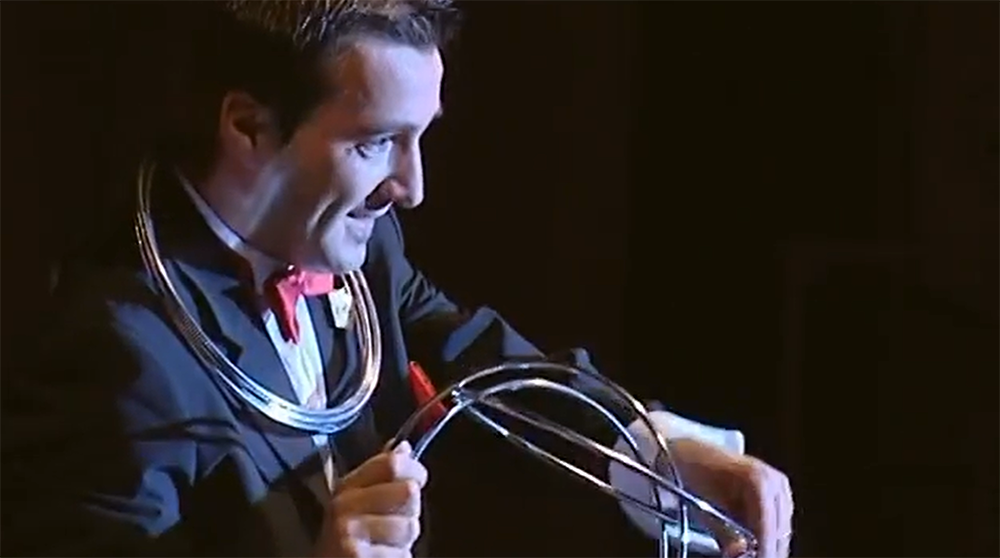
BARI, Italy — MALIBU, California, USA, March 18, 2026 — There is a certain poetry and a dose of irony in what set the internet magic community buzzing this week.
For years, an anonymous account called The Mask Magic has built a following of millions across YouTube, Instagram, Facebook, and TikTok by doing one thing: revealing how magic tricks are done. No permission from the performers. No compensation to the creators. No regard for dealers. Just methodical, monetized exposure of trade secrets that working magicians spent careers developing.
On March 16, Mishaal Khan — cybersecurity professional, author, virtual Chief Information Security Officer, and one of the most credentialed open-source intelligence investigators in the field — posted a video documenting his investigation into the identity of the person behind the mask. He called it a masterclass in OSINT (Open-Source Intelligence). It took him roughly an hour to do his work.
“What kind of a person hides behind a mask to protect their own secret while ruthlessly exposing the artistry and hard work of others?” Khan asks as his investigation video begins.

Conjurly reviewed Khan’s findings and conducted independent verification. The conclusions hold. They hold down to the scratches on a guillotine prop.
The Account
The Mask Magic’s YouTube channel, @themaskmagictricks, is the operation’s largest by consumption — more than 459 million views across 2,711 videos, with 1.21 million subscribers since the channel launched on March 30, 2021. Its Instagram page, @themaskmagic, has grown to 2.8 million followers. The Facebook page has 209,000 followers. A TikTok account, @themaskmagictricks, extends the reach further still.
The account describes itself as offering “mind-blowing magic tricks, stunning illusions, and thrilling performances — all with a mysterious twist.” Business inquiries were directed to a Gmail address. A location — Italy — appeared in the YouTube profile. The operator never showed his face.
What the account actually does is expose the methods behind magicians’ performances and tips the secret workings of commercially marketed effects. The tricks being revealed are, in the language of the community, trade secrets — the intellectual property of working performers who depend on the integrity of their craft for their livelihoods.
The magic community had been watching and fuming for years. Magicians wondered and speculated about who was behind the mask. Then a magician friend brought the identity puzzle to Mishaal Khan.
The Investigator
Khan is not a curious hobbyist who stumbled into a clever search. He is a working professional with more than two decades of experience in cybersecurity, ethical hacking, social engineering, and privacy. He has spoken at Black Hat, six times at DEF CON, six times at Wild West Hacking Fest, and at TEDx. His certifications include CCIE, Certified Ethical Hacker, and Certified Social Engineer Pentester. He holds the distinction of being the first Open Source Intelligence Professional credentialed by IntelTechniques, the training organization founded by former FBI Cyber Crimes Task Force investigator Michael Bazzell. He runs a cybersecurity practice as a vCISO, owns a privacy management and investigations firm, and is the author of “The Phantom CISO.” He is based in Malibu, California.
When the friend brought Khan this challenge, they brought it to the right person.
The Investigation
The challenge presented to Khan was straightforward: someone was copying famous magicians’ performances, exposing their methods without consent, building a large monetized following, and hiding behind a mask to do it. Could Khan figure out who he really was?
He took the challenge and documented every step of his process on video.
Starting with the Gmail address visible in the account’s public profile, Khan ran it through standard searches, cross-referenced it against the breach database HaveIBeenPwned, and used a tool that converts a Gmail address to a Google ID — which he then checked for Google Maps review activity. Nothing immediately useful. He then ran the address through Holehe, a Linux-based tool that checks username registration across hundreds of platforms. The Gmail account appeared on three: Firefox, Twitter, and — notably — Office 365.
That last one opened a door. Using Office 365’s password reset function, Khan obtained a partial recovery email address and a partial phone number. Then he tried something more direct: sharing a OneDrive folder with the Gmail address. When OneDrive resolved the contact, it returned a name — Mago Dominik. In Italian, mago means magician.
Searching the name Mago Dominik, Khan found a website touting a magic trick marketed by an Italian performer: Domenico Chimienti, from Bari, Italy, born in 1973. The site showed a video of only his hands performing a trick called “the Platinum Bill to Lemon” with Chimienti’s photo on the packaging. It also included a photograph with Silvan, one of Italy’s most celebrated magicians and a signed endorsement of the effect.
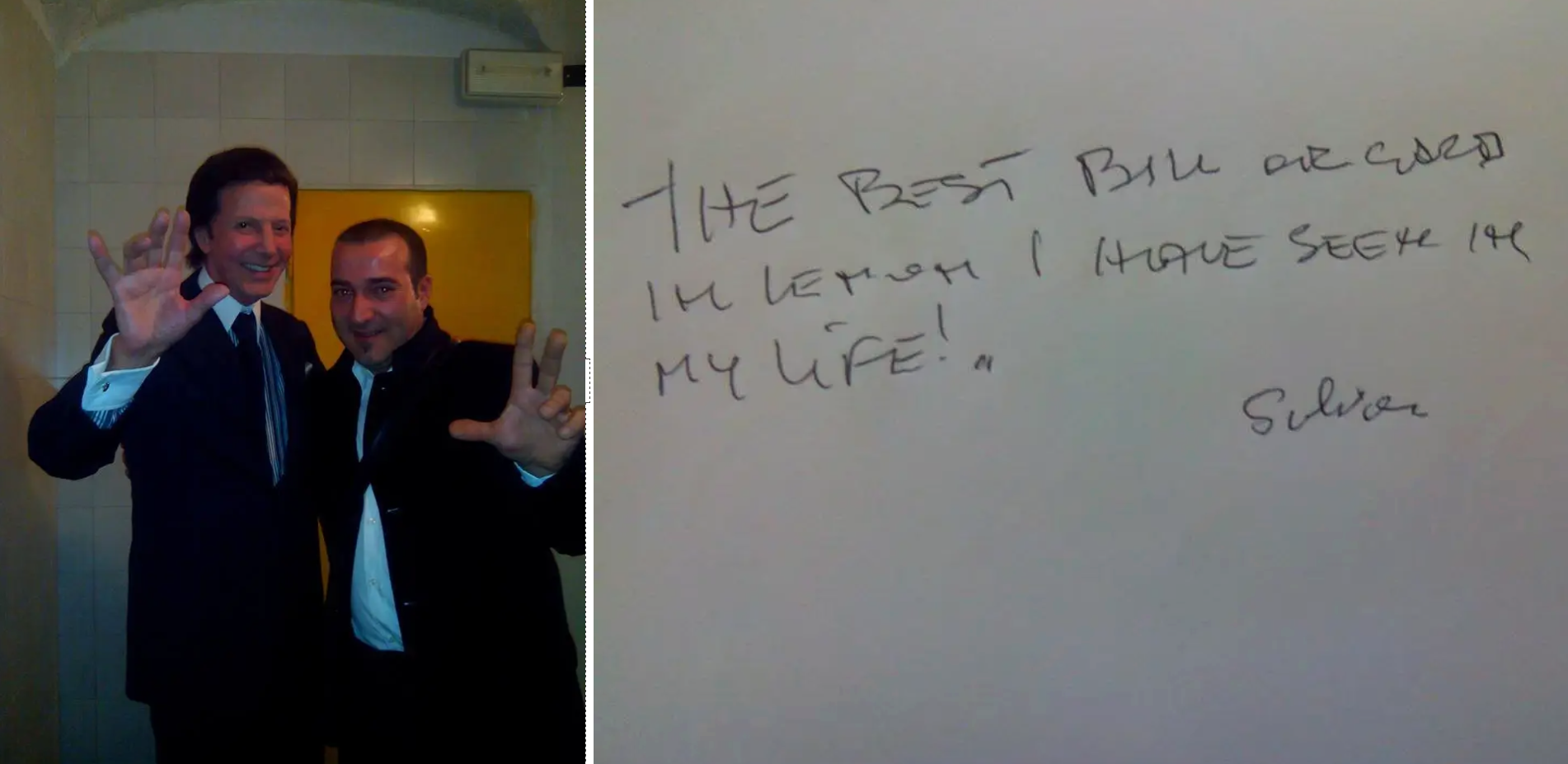
Now he had a face. The question was whether it matched the figure in The Mask Magic videos.
Khan went through hundreds of videos looking for visual anchors — floor tiles, furniture, anything in the background distinctive enough to cross-reference. After reviewing hundreds of clips, he found one: a flower pot visible in an older Mask Magic video that matched one in Chimienti’s personal social media profile exactly.
From there, the corroboration stacked quickly. A red couch. A picture frame. A door frame. A set of glasses on a table. A guillotine prop. Using a second email address found in the YouTube profile — this one ending in .it, the Italian country code — Khan found additional breach records with a date of birth matching the 1973 year from the Italian website, down to the month and day. The Mask Magic had posted a birthday video on that same date, marking his 50th birthday.
Khan also found Chimienti’s name embedded in one of his breached passwords, and confirmed it by initiating a PayPal transfer to his email address, which returned the name Leonardo Chimienti, before any transaction could occur. Khan concluded this was likely the individual’s legal name.
Conjurly’s Independent Verification
Khan’s findings were compelling. Conjurly’s standard is to verify facts before publishing.
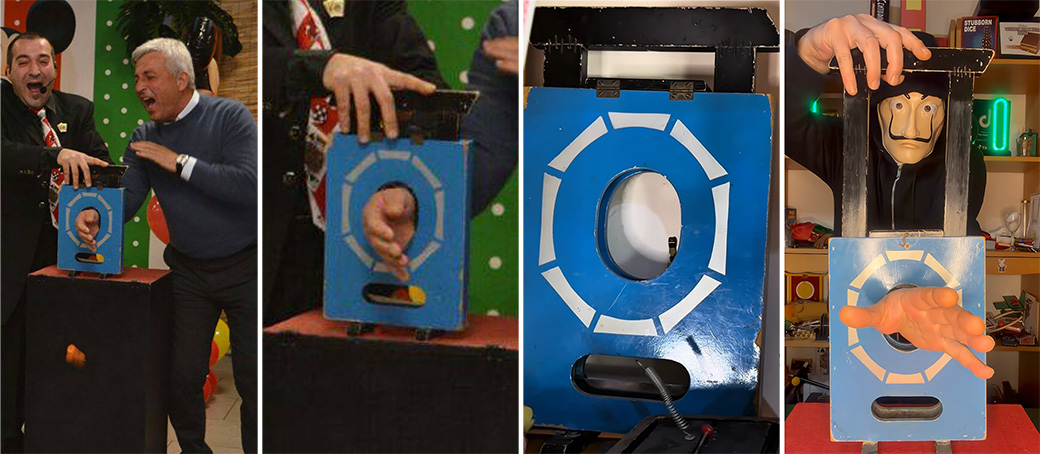
One item on Khan’s mind map raised curiosity about a detail. Khan spoke of a hand guillotine trick while in the background a picture from The Mask Magic’s YouTube channel clearly displayed a very different hand guillotine than type seen used by Mago Dominik. That incongruity launched us on some confirmation sleuthing.
Working from photos of Chimienti performing publicly as Mago Dominik that Conjurly located on an Italian kids show magician booking website and comparing them to a close-up video shot from a studio tour segment on The Mask Magic’s YouTube channel it became clear that The Mask Magic has two different hand guillotines. For the one that was obscured from view rather than prominent in the mind map photo, the match is unambiguous. The guillotines match — not merely the same model, but unquestionably the identical physical prop with visible wear and tear marks that match up.
The Subject
The person behind the mask, Khan concluded — and Conjurly’s fact-checking confirms — is Leonardo “Domenico” Chimienti, 53, a magician from Bari, Italy.
Chimienti tried to hide his identity, unaware of the number of tricks one of the world’s top OSINT experts has up his sleeve — enough to turn a Dalí mask into a transparent veil in under an hour.
Conjurly reached out to Chimienti by email requesting comment. No response was received prior to publication.
The Irony on Record
At some point while building an account devoted to exposing other people’s secrets, Chimienti posted to Facebook complaining that someone had been stealing his videos and his identity without his consent.
Khan caught that detail and made sure it was in the video.
A Note on Names
Chimienti is not the only magician performing under a variation of the Mago Dominik name, and the distinction matters.
Domenico Di Carlo — known online as Mago Domin and also Mago Dominik — is a highly regarded Italian illusionist and street magician with more than 600,000 Instagram followers and 1.7 million on TikTok. He is a 2025 Merlin Award winner. He has no connection to The Mask Magic account or to Chimienti.
El Mago Dominic, the Peruvian illusionist who uses @dominicmagic_ on Instagram, is a stage and comedy magician in Lima and a first-place winner at the 6th World Magic Festival. He likewise has no connection to this matter.
Conjurly verified both before publication and wants to help make sure no ire is misdirected toward innocent parties sharing similar stage names.
Comments From Around the Magic Social Media World
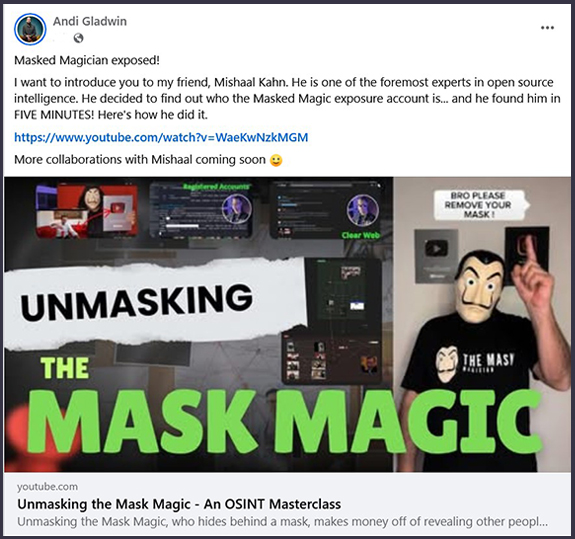
Vanishing Inc. co-founder Andi Gladwin introduced Khan’s findings to the magic community on Facebook. The reaction was swift — setting the magic world buzzing across multiple social platforms.
Tim Ellis, the Australian magician and magic educator, noted the remarkable timing on Facebook. “I spoke about him in my lecture tonight,” Ellis wrote, “less than an hour ago he was exposed on YouTube. Let’s make him famous!”
On Reddit’s r/magic community, a thread erupted almost immediately. “This isn’t about revealing base gimmicks like a detachable thumb or similar tricks,” wrote user SolaceRests. “It’s throwing out one’s integrity and backstabbing the community for the sake of getting ‘likes.’ Yes, anyone can research tricks and figure out how to do them on their own if they want to put forth that level of effort, but what this guy has done is throw it all out there — which cheapens the craft and is a slap in the face to the professionals that uphold its integrity.”
Craig Petty, the British magician and magic creator known for his unfiltered commentary laced with profuse profanity, put it more directly. “Those who can do,” he wrote on Facebook. “Those who can’t teach. Those who can’t teach expose magic and don’t even have the balls to tell everyone who they are. Take your mask, turn it sideways and shove it up your ass Mago Dominik you prick.” He closed with: “Congratulations to all involved!”
Canadian magician Martial Tremblay added his thoughts to the chatter writing simply, “now what?”
Gladwin, whose Vanishing Inc. is one of the magic world’s most respected dealers and a platform for independent creators, told Conjurly he’s watching to see what comes next.
“I think the most interesting part of this adventure is yet to come. What will happen next? Will he shut down his exposure operations, or will he continue to act as though nothing has happened? Now that the cloak of anonymity has been removed, I hope he uses this as an opportunity to do good things and to make up for the damage he has caused to so many creators.”
What It Means
The magic community has contended with secret-exposers as long as there has been a magic community. Val Valentino — the original Masked Magician of 1990s Fox television fame — at least revealed himself at the end of his run and offered a justification, however disputed: that exposure would force the art to evolve. Chimienti has offered no such rationale and sought no such accountability. He built his following anonymously, attempted to stay anonymous, and monetized the content.
Conjurly has been unable to uncover evidence that Chimienti is a member of any of the major magic societies. So a very public banning may not be ahead like the one fellow internet magic exposer Murray Sawchuck received from the Magic Castle. One thing is certain — it is unlikely Mago Dominik will be peddling his Platinum Bill to Lemon magic trick at any magic conventions soon.
The Broad View
The broader question Khan’s investigation raises has nothing to do with magic. It is about the digital trail that all of us leave behind whether we intend to or not. The flower pot that first gave Chimienti away was not a careless slip. There were simply details he never thought to manage — the thousands of ambient facts that accumulate across years of online life. His downfall was not a single mistake. It was the slow accumulation of ordinary moments, captured in the background of videos he thought made him untraceable.
Khan’s investigation is, among other things, a reminder that online anonymity is not a default condition. It requires active, sustained effort. And for most people — and apparently for at least one mask-wearing secret-exposer from Bari, Italy — it does not get that effort.
Khan, for his part, sees the bigger picture. “Behind the veil of the internet, trolls and scammers hide behind their masks,” he told Conjurly, “but I’m just leveling the playing field by exposing their deceit, empowering others to stand tall and fight back with confidence.”
Responses