
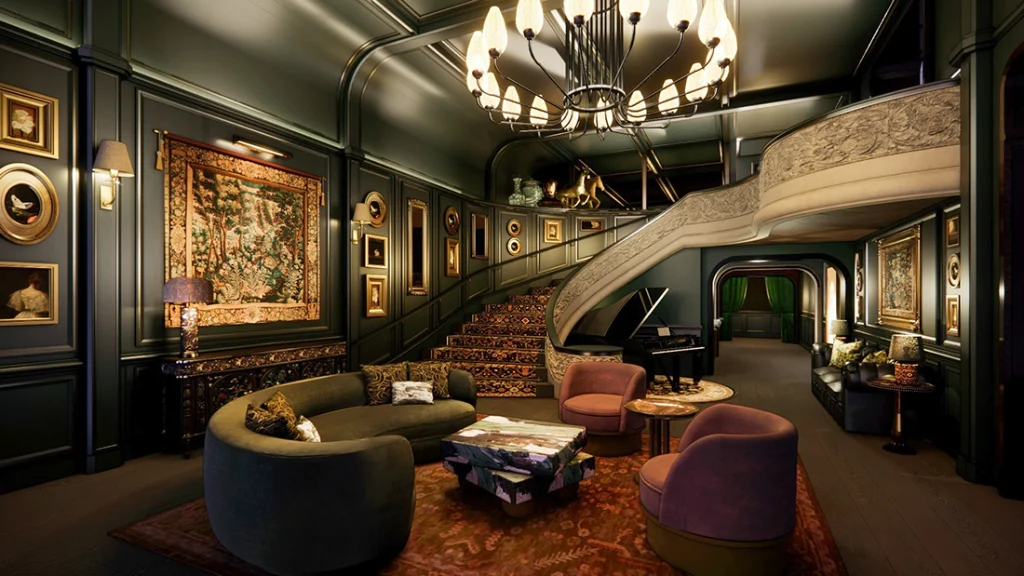
Chicago, April 19, 2026 — The Hand & The Eye welcomed its first public audiences Saturday, April 18, in the heart of downtown Chicago. Located just steps from the Magnificent Mile, the curtain rose on the magic world’s most ambitious venue after years of anticipation.
Billing itself as the largest magic venue on earth, the $50 million, 36,000-square-foot immersive destination inside the historic McCormick Mansion at 100 East Ontario Street features dining rooms, bars, and performance spaces designed to immerse guests in performances by magicians from around the world.
Behind it is Glen Tullman, a Chicago entrepreneur who made his fortune in health technology and spent $50 million of it on a magic venue — every dollar his own. The Hand & The Eye is, he has made clear, not a business venture in any conventional sense, but a long-held personal pursuit. It is a passion project driven by a man who worked toward seeing Saturday’s debut for decades.
The question of what this opening means for the magic world — and whether an art form that has thrived with marquee stars in Las Vegas showrooms and in intimate neighborhood venues can produce a return on a $50 million investment in something entirely different from both — is one Conjurly explored here last month and has the magic community buzzing with opinions. Only time will reveal the answer. The clock started ticking this weekend.
Twenty-Seven Years in the Making
Tullman is not a magician by profession. He is a 66-year-old Chicago health technology entrepreneur whose company Transcarent has made him one of the wealthier figures in that industry. But magic has been with him his entire life.
“When I was a kid, I was fascinated with magic because as I watched, I was filled with awe and wonder,” Tullman wrote in a LinkedIn post ahead of opening. “And more importantly, so were all the people around me.”
That instinct — magic as a shared experience rather than a solo one — is the philosophical foundation of everything he has built here. And he has been trying to build it for a long time.
In 1998, Tullman and designer David Rockwell were deeply involved in Magic Underground, a David Copperfield-fronted venue set to open in Times Square. With the creative team and financial investors at odds and the project already over budget, backers pulled out near completion. Tullman absorbed the lesson completely.
“The primary thing that didn’t work was financing,” he recalled. “So I said, ‘Next time, I will finance it personally.'”
Chicago was not an accident. “We chose Chicago on purpose,” Tullman wrote. “The City of Big Shoulders supports Big Ideas that are built with intention, and Chicagoans know when something is well done.” He cited the city’s history of close-up magic — its own name, Chicago-Style — and the figures who built that tradition.
Tullman arrived at the Saturday evening grand opening carrying a line he says has guided the whole project, the famous joke about the boy who tells a magician he wants to grow up to be just like him.
To which the magician replies: “Sorry, kid. You have to choose one or the other.”
“In pursuing this project,” Tullman wrote, “I guess I chose.”
The Creative Team
Tullman is the dreamer. David Rockwell is the builder.
The celebrated designer whose firm has shaped Broadway productions, Nobu restaurants, and the Dolby Theatre in Los Angeles was the natural collaborator for a project that exists at the intersection of performance and dining.
“This was a once-in-a-lifetime opportunity,” Rockwell said, “in that it tied together my two main interests in how people come together, which is performance and dining. It also came with a fascinating unicorn of a building with a monolithic facade that is both elegant and mysterious and entirely differentiated from every other building nearby.”
Magic, it turns out, was also the start of something for Rockwell. As a boy in New Jersey — the same state where Tullman grew up — he sent away for blueprints of stage illusions and performed a saw-a-lady-in-half at a school show. He says she lived. Magic, he has said, was the beginning of his interest in architecture and theater. The two men’s parallel obsessions, discovered decades into a friendship, help
explain why this project exists at all.
A Mansion Reborn
The building at the center of all of this was constructed in the late nineteenth century as the private residence of industrialist Leander McCormick. It became a casino in the 1930s, then the Kungsholm Grand Opera Puppet Theatre in the 1940s, and most recently housed Lawry’s Prime Rib for nearly 40 years before the pandemic closed that chapter in 2020. Tullman saw possibility where others saw vacancy.
Rockwell and his team gutted much of the building and rebuilt it from the inside out. The result — multiple theaters, two dining rooms, eight bars, a rooftop space, and a members-only club — was designed with a single discipline in mind: close-up magic. Every physical detail serves that purpose, from the sightlines of the seats to the width of the drinking glasses, which are sized to accommodate a playing card.
Each room carries its own color and character, moving through rich shades of turquoise, emerald green, and crimson red, furnished with bespoke chandeliers, velvet armchairs, and patterned wallpaper. Where the original mansion offered something worth keeping — a grand staircase, a fireplace — Rockwell kept it.
The overall impression is one of opulence — rich, layered, and unmistakably theatrical — without ever feeling like a costume.
The Magic Team
The artistic direction of The Hand & The Eye was handed to Jeff Kaylor, an internationally acclaimed working magician who has performed in over 400 cities across 40 countries over 17 years. Kaylor made a defining choice when the project came together — he stepped away from a successful touring career and relocated to Chicago to help build it from the ground up.
His vision for the venue is specific and unambiguous: a space dedicated to close-up magic, where audiences put their phones away, lean in, and witness the art the way it was meant to be seen — live, up close, and very personal.
Alongside Kaylor, Michael Ammar serves as the company’s artistic elder statesman. At 69, Ammar is one of the most influential magicians of the twentieth century — a performer of more than 50 years with appearances on Johnny Carson’s Tonight Show and stages from the Magic Castle to the Vatican. The magic community knows him simply as “The Professor.” His presence here is a statement of artistic intent.
Nick Locapo, who packed up his life in Columbus, Ohio, and relocated to Chicago, serves as senior vice president of magic. He brings a background as the official magician of Penguin Magic — the world’s largest magic retailer — and as a founding member of the P3 Magic Theater, where he spent over a decade at the forefront of live performance. In his role at The Hand & The Eye he oversees performance standards and magician development, ensuring that the level of astonishment promised by the venue is delivered, night after night.
Among the resident performers is Gali Novak, a 26-year-old Australian who articulated what draws serious practitioners to a purpose-built space: other venues, she noted, ask magicians to perform in imperfect conditions, and those conditions directly limit the level of astonishment that is possible.
The venue is slated to maintain a core roster of 22 magicians enhanced by additional guest performers.
The Experience
“A lot of people think this is dinner with magic. That’s not what it is,” said Bre Smith, the executive vice president of operations.
Smith, whose background includes the Ritz-Carlton, Ambassador Chicago, and Soho House, came to the project with a philosophy that aligns closely with Tullman’s own. “When I think about magic, I don’t think about a moment,” she wrote ahead of opening. “I think about people.”
Tullman’s directive to her was equally clear: “I don’t want you to worry about the revenue. I want you to worry about the experience.” To deliver on that experience at scale, Smith oversees the venue’s partnership with Levy Restaurants, the Chicago hospitality institution that runs the food and beverage operations across the mansion’s two dining rooms and seven bars.
“Everyone on our team is a part of creating a genuine experience,” Smith said. “They are each empowered to create magic moments for our guests and our message is simply that everyone has their own magic to share.”
The experience begins before any magician appears. Upon arrival, guests are ushered into a small entry room where a 1920s-era telephone rings. A woman’s voice provides instructions on what to do next.
From there, guests receive a hand-illustrated map and a personalized itinerary guiding them through the evening. Rockwell described the design intent: “Our design guides guests on a uniquely tailored journey among a variety of unique and different performance spaces, opulent bars, and captivating dining rooms that blend motifs from past for an almost out-of-time, mystical experience.”
Performance spaces include the 30-seat Coliseum theater for close-up acts, the large Monarch performance area, the intimate 10-seat Red Herring bar, and a hidden underground Vault theater for final shows. The Monarch Room — the largest of the five theaters — seats 96, with blue velvet wall coverings and the only stage in the venue scaled for parlor magic.
“This is really building that third home,” Smith said. “It’s taking you away from work. It’s taking you away from your home and coming to a place where you completely disconnect. There are very limited windows in the mansion. We don’t allow photos, and you hardly see any illuminated screens.”
The two dining rooms are intentionally magic-free zones. The rhythm of the evening is show, then dinner, then another show, with time at the bars where the conjuring continues.
Tullman framed it: “This is not something you go to see. It’s an experience you have and are a part of. And once you have the experience, you want to share it with others because it’s impossible to describe, like a picture that doesn’t capture something you saw. You must be there to feel it.”
Dining
Levy Restaurants, twice named one of the 10 Most Innovative Companies by Fast Company and a fixture at events from the Super Bowl to the Grammy Awards, is running the food and beverage operations.
CEO Andy Lansing is a magic collector and practitioner in his own right. “This project combines two of my great passions — creating great dining experiences and exploring every aspect of the world of magic,” Lansing said. “Both are about delighting someone.” Part of his personal collection of historic magical artifacts will be on display at the venue.
The culinary program features elevated classics like Chicken Vesuvio and prime beef carpaccio alongside nostalgic relish plates and grasshopper baked Alaska. Each of the seven bars offers four cocktails named for the suits in a deck of cards, plus one specialty drink tied to Chicago’s history.
Membership and Details
Membership at The Hand & The Eye is designed to open deeper layers of the mansion — additional spaces, a private bar and dining room, all accessible through a members-only entrance.
The venue describes membership as a path to community: “Through returning and witnessing moments together, community forms. What is shared carries forward, shaping the culture of the Mansion beyond any single visit.” Full membership details had not yet been released as of opening weekend.
Tickets for an evening at The Hand & The Eye start at $225, which includes a $75 dining credit.
The venue enforces a cocktail attire dress code and an adults-only policy. Guests are prohibited from taking photos or videos during performances.
Hours are Sunday through Wednesday, 4 to 10 p.m., and Thursday through Saturday until 11 p.m. Reservations are required at thehandandtheeye.com.
What the Magic World Is Saying
The magic community’s response to The Hand & The Eye has been a mixture of genuine excitement and legitimate skepticism.
Jamy Ian Swiss — magician, prolific author, and one of America’s most prominent voices for scientific skepticism, with more than thirty years of activism promoting critical thinking and rational inquiry that extends well beyond the world of magic — addressed one of the magic community’s central concerns about the venture: whether quality can be maintained across a large rotating roster of performers working seven nights a week. Speaking to the New York Times, he chose his words carefully: “It’s a valid concern. I’m not going to pass a judgment, but I would say only that magic is often underestimated as a craft.”
Jim Steinmeyer — illusionist, magic historian, and former president of the Magic Castle, who has served as a consultant to Siegfried & Roy and David Copperfield — called the project “incredibly ambitious.” “Magic looks great when the audience is close to it,” Steinmeyer said. “You want to be close enough to appreciate it, and you don’t want to be looking from the back row.”
On magic social media, the chatter has been both optimistic and skeptical. Those who attended the preview event were largely enthusiastic — the venue itself drawing near universal admiration — but the praise came with questions that only time will answer. Is the price point sustainable for repeat visits? Will the experience hold its magic beyond the novelty of opening weekend? And perhaps most pointed of all — is this a place for the magic community, or simply for those who can afford a $225 per person night out?
Tullman acknowledged the gamble without apparent anxiety. “I’ve often said to people that either this will work or I will live in the nicest house in Chicago. There is no in between.”
The Stakes
Long before the world’s largest magic venue arrived on the scene, Chicago was the birthplace of modern close-up magic — a style defined by intimacy, personality, and impossibility happening inches from the spectator.
Figures like Matt Schulien, Bert Allerton, Johnny Paul, and Ed Marlo helped define that tradition in restaurants, bars, and small rooms across the city. Their work established a philosophy of magic that prioritized connection over spectacle.
Chicago-Style magic was born on small wooden tables surrounded by less than comfortable bistro chairs and on drink-stained bar tops. That stands in stark contrast to the opulence and grandeur of The Hand & The Eye, which is something fundamentally different.
At its core, The Hand & The Eye represents a paradox. The project moves toward scale, infrastructure, and destination-level experience. The same ambition that makes the venue exciting also raises questions about whether the essence of the art form can survive in a setting designed for volume and throughput.
A project of this size carries unusually high stakes. There is no quiet middle outcome.
A $50 million magic venue will either be the best thing that happened to magic’s public profile in a generation, or an ugly reputational stain that fuels an argument that magic cannot sustain projects requiring serious investment. The results, success or failure, will affect everyone involved in magic. The magic community does not get to sit this one out.
Chicago-Style magic has always been built in small rooms. This weekend, someone tried to build it in a mansion. Chicago will decide what that means. And the decision will reverberate around the world.
For Tullman’s sake and for the sake of all who are involved in and love magic, we hope the project is a success — an industry-defining success.
Responses